
Is GEYOTO Worth It? A Guide to Portable Power Solutions

GEYOTO Portable Power is a newer name in a crowded market, and that alone makes people hesitate. Bluetti, EcoFlow, Jackery and Anker have years of reviews behind them. GEYOTO only started selling its full line in the US in May 2026.
So is it worth your money? For the right buyer, probably yes. For others, there are safer picks. This guide covers what GEYOTO actually sells, how the specs hold up, what early owners say, and who should look elsewhere.
Quick Answer: Is GEYOTO Portable Power Worth Buying?
GEYOTO looks like good value for light-to-moderate use: camping, short outages, remote work and RV trips. Its stations use LiFePO4 batteries rated for 4,000 cycles, and the pricing undercuts many established brands. The trade-off is a short track record and very little independent lab testing. If you want a proven name with years of support history, that matters.
Who Is GEYOTO?
GEYOTO is the consumer brand of GEYOTO Technology Limited, a portable energy company that sells power stations and solar products. According to its launch announcement, the company brought its full product line to the US market in May 2026, with sales through its own website and Amazon. A compact model, the C260, followed in November 2026, adding TikTok Shop to the mix.
One thing to keep in mind: most of what’s written about GEYOTO online comes from press releases and brand-published pages. Independent hands-on reviews from major tech outlets are still thin. That’s normal for a young brand, but it means you should weigh owner feedback and the warranty a little more heavily than usual.
The GEYOTO Lineup at a Glance
GEYOTO currently centers on three power stations. They serve quite different needs.
| GEYOTO C260 | GEYOTO N300 | GEYOTO N1000 | |
|---|---|---|---|
| Capacity | 256Wh | 256Wh | 1,024Wh |
| Output | Up to 100W (DC) | 300W rated, 500W peak (AC) | 1,800W rated, 3,000W peak (AC) |
| AC outlets | None | 3 | 4 |
| USB-C | Yes (port limits apply) | 3 ports, up to 65W | 4 ports, up to 140W |
| Solar input | Check listing | Up to 140W | Up to 800W |
| Weight | 3.64 lb | 7.72 lb (without silicone armor) | 25.57 lb (without silicone armor) |
| Battery | See listing | LiFePO4, 4,000 cycles | LiFePO4, 4,000 cycles |
| Best for | Backpack carry, laptops, phones | Camping, CPAP, light backup | Home backup, RV, mobile office |
Specs come from GEYOTO’s own product pages and press materials. Confirm the figures on the current listing before you buy, since brands tweak specs between production runs.
GEYOTO N300: The Everyday Camping and Backup Pick
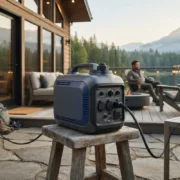
The N300 is the sensible middle of the range. It packs 256Wh into a body of roughly 7.7 pounds, which is easy to carry to a campsite or move around the house.
What it does well:
- Pure sine wave AC output at 300W, with 500W available for brief startup surges.
- Three AC outlets plus USB-C, USB-A, a car port and 25W wireless charging on top.
- Fast wall charging. GEYOTO says a full recharge takes about 1.4 hours.
- UPS switching under 10 milliseconds, which is useful if you want it to act as a small backup for a router or modem.
GEYOTO’s published runtime estimates give a feel for the capacity: roughly 20 hours for a 10W LED light, around 4 hours for a 48W Wi-Fi router, and about 2 hours for a 90W CPAP machine. Those are best-case figures. Real-world runtime is lower because of conversion losses, so plan on using about 80% of the rated capacity.
A 300W limit also rules out a lot. Coffee makers, hair dryers, space heaters and most power tools will exceed it. The N300 is for phones, laptops, cameras, lights, small fans and similar light loads.
GEYOTO N1000: The Home Backup and RV Option
The N1000 is the big one. Its 1,024Wh battery and 1,800W of rated output (3,000W peak) let it handle things the N300 can’t, including mini fridges, many CPAP setups over longer stretches, a microwave or a small space heater for short periods.
Highlights from the official specs:
- 13 output ports, including four AC outlets and four USB-C ports (up to 140W)
- Up to 800W of solar input
- AC charging from 0 to 80% in about 43 minutes, and a full charge in roughly 68 minutes
- The same 4,000-cycle LiFePO4 battery and sub-10ms UPS switching as the N300
At around 25.6 pounds before the silicone shell, it’s not something you’d carry far. Think car camping, a van, an RV or a closet shelf for outage season.
For whole-home needs such as central air, an electric range or a well pump with a heavy startup load, no unit this size is enough. A larger home battery system or a standby generator is the right tool for those jobs.
GEYOTO C260: The Ultra-Light, DC-Only Option
The C260 is the odd one out, and it’s more interesting than it first appears. It’s a 256Wh station weighing just 3.64 pounds, designed to slip into a backpack next to a laptop. The catch: it’s built around DC and USB-C output, with up to 100W total, and has no AC outlet.
That design choice is deliberate. Many people today charge phones, tablets, laptops, cameras and drones over USB-C, so an inverter adds weight and cost they don’t need. According to GEYOTO, it launched on Amazon on November 1, 2026 from $99.99, with the official site and TikTok Shop following on November 10.
Choose it if everything you carry charges over USB-C or a car-style port. Skip it if you need to plug in a standard wall-plug device.
Battery Quality and Safety
All the GEYOTO stations covered here use LiFePO4 (lithium iron phosphate) cells. This chemistry has become the standard for better power stations because it handles heat well and lasts far longer than older lithium-ion designs. GEYOTO rates its cells for 4,000 cycles. If you used one for a full cycle every day, that would be more than a decade of use, though real-life aging depends on temperature, depth of discharge and storage habits.
The company also advertises built-in battery management and safety certifications. Treat certification claims the way you would for any brand: check the product listing or manual for the specific certification mark and number rather than relying on marketing copy.
What Owners Say
Feedback so far is limited, so take this with some caution. Reviews on Trustpilot lean positive, with owners praising quick setup, a clear display, easy solar charging and reliable overnight power during a blackout, including for a CPAP machine.
The criticisms are small but worth noting:
- One reviewer said the fan gets loud under heavy load.
- Another noticed the unit drains slowly while sitting in storage.
Neither is unusual for the category. Almost every power station slowly self-discharges, and fans spin up when you push the inverter. Still, they’re good reminders to top the battery up every few months and to expect some noise at high output.
Because the brand is new, the sample of reviews is small. A few dozen reviews can’t tell you how the units hold up after three years.
Warranty and Support
GEYOTO offers a 3-year standard warranty, which can be extended to 5 years when you register as a member on its site. That’s competitive for the price range and a real point in its favor, since warranty length is one of the few ways a new brand can back up its claims.
Two cautions. Read the registration terms before assuming you’ll get the full 5 years, and keep your proof of purchase. With a newer company, you also want to know it will still be around to honor the warranty. That’s a risk you can’t fully eliminate.
Price and Value for Money
GEYOTO’s own site lists the N300 and N1000 at heavily discounted prices compared to their crossed-out list prices, with the N300 near the $190 mark and the N1000 near $400 at the time of writing. The C260 started at $99.99 at launch.
Sale prices like these change often, so check the current number on the product page before buying.
On paper, the value is strong. A 1,024Wh LiFePO4 station with 1,800W output at that price undercuts many bigger names. That’s the main reason to consider GEYOTO: you get more watt-hours and watts per dollar. What you give up is a long record of independent testing and a proven service history.
Pros and Cons
Pros
- LiFePO4 batteries rated for 4,000 cycles across the lineup
- Strong capacity and output for the price
- Fast AC recharging, with the N1000 reaching 80% in about 43 minutes
- Solid port selection, including 25W wireless charging
- UPS switching for light backup duty
- 3-year warranty, extendable to 5
- A genuinely portable DC-only option in the C260
Cons
- New to the US market with limited long-term track record
- Few independent lab-style reviews so far
- N300 is limited to 300W, which excludes many appliances
- N1000 is heavy for anything beyond car or RV use
- Some owners mention fan noise under load and slow self-discharge
- Extended warranty requires registration
Who Should Buy GEYOTO?
- Campers and van lifers who want good capacity without paying for a big brand name
- Remote workers and travelers who need laptop and phone power on the go (the C260 or N300)
- People preparing for short outages who want to keep a router, phone, CPAP or mini fridge running
- Budget-conscious RV owners comparing the N300 and N1000 for mixed use
- Shoppers who value warranty length and are comfortable with a newer brand
Who Should Skip It?
- Anyone who wants a long-established brand with years of independent testing
- Households needing to power central air, electric ranges, well pumps or other heavy loads
- Buyers who need to run standard AC devices from an ultra-light unit (skip the C260)
- People who plan to use a station as their only medical backup. Check your device’s exact power draw and keep a second plan, since no portable battery is a guaranteed lifeline
GEYOTO Alternatives
If GEYOTO doesn’t feel right, these are the brands most shoppers compare it with:
- Jackery, for brand familiarity and wide retail availability
- EcoFlow, for fast charging and an app-driven ecosystem
- Bluetti, for expandable systems and a deep range
- Anker SOLIX, for a trusted electronics brand name and strong support
- Fanttik and Bigblue, for budget-friendly small stations
Expect to pay more for the established names at comparable specs. Whether the premium is worth it depends on how much weight you give to track record.
How to Choose the Right Size
Size the station to your devices, not to the biggest number on the box.
- List what you want to power and find each item’s wattage on its label.
- Add up the watts you’d run at the same time. That total must stay under the station’s rated output.
- Estimate hours of use and multiply by wattage to get the watt-hours you need.
- Add a buffer. Plan around 80% of the rated capacity.
- Check startup surges. Motors and compressors briefly draw far more than their running watts.
As a rough rule: phones, laptops and lights suit the C260 or N300. Fridges, CPAP over multiple nights and a mobile office suit the N1000.
A Safety Reminder
Never run a gas generator inside a garage, basement or near open windows. Carbon monoxide from generators is a well-documented cause of deaths during outages. A battery power station produces no exhaust, which is one of its real advantages for indoor emergency use. Keep any power station ventilated, away from water, and out of extreme heat.
FAQs
Is GEYOTO a good brand?
GEYOTO offers strong specs and warranty terms for the price, and early owner feedback is mostly positive. It’s a young brand in the US, so there’s less long-term evidence than for older names. It’s a reasonable pick if you’re comfortable with that.
Where is GEYOTO sold?
GEYOTO sells through its official website and Amazon, and its newer C260 is also on TikTok Shop. For warranty registration and support, buying from the official site or an authorized listing is the safest route.
How long does a GEYOTO power station last?
The N300 and N1000 are rated for 4,000 charge cycles with LiFePO4 cells. Actual lifespan depends on how you use and store them.
Can the GEYOTO N300 run a mini fridge?
It’s not ideal. A small fridge’s compressor can create startup surges and long runtimes that a 256Wh, 300W unit handles poorly. The N1000 is a better fit for refrigeration.
Can I charge a GEYOTO station with solar panels?
Yes. The N300 accepts up to 140W of solar input and the N1000 up to 800W. Real charging speed depends on sunlight, panel quality and angle.
Does GEYOTO work as a UPS?
Both the N300 and N1000 list UPS switching under 10 milliseconds, which suits routers, modems and many small electronics. Test it with your own equipment before depending on it.
Can I take a GEYOTO power station on a plane?
Airlines limit lithium batteries by watt-hour rating, and large power stations generally exceed those limits. Check your airline’s current rules before traveling.
How long does the warranty last?
GEYOTO states a 3-year standard warranty, extendable to 5 years by registering as a member.
Final Verdict
GEYOTO Portable Power makes a good case for itself. The N300 suits campers and light backup, the N1000 offers real home and RV capability at an aggressive price, and the C260 is a smart pick for travelers who live on USB-C. LiFePO4 cells, fast recharging and a 3-to-5-year warranty are the strongest reasons to buy.
The honest caveat is time. This is a young brand with limited independent testing. If you’re comfortable with that, GEYOTO is worth a serious look. If you’d rather pay extra for a long-proven name, the established brands are still the safer route.
Final Thought
Don’t shop by the biggest number on the box. Match the station to the devices you actually plan to run, check the current price and warranty terms on the official page, and buy from an authorized seller. A smaller unit you’ll carry and use beats a larger one that stays in the closet.
What is your reaction?